Buy easycrm.eu ?
We are moving the project
easycrm.eu .
Are you interested in purchasing the domain
easycrm.eu ?
domain@kv-gmbh.de · 0541-91531010
Buy easycrm.eu ?
Which vocabulary app scans the vocabulary list?
The vocabulary app that scans the vocabulary list is Quizlet. Quizlet allows users to scan their physical vocabulary list using their phone's camera, which then creates digital flashcards for studying. This feature makes it convenient for students to quickly digitize their vocabulary lists and access them for study on the go. **
What is the term for the vocabulary of nonverbal communication?
The term for the vocabulary of nonverbal communication is "kinesics." Kinesics refers to the study of body language, facial expressions, gestures, and other nonverbal cues that convey meaning in communication. Understanding kinesics is important for interpreting and responding to nonverbal signals in social interactions and can help improve overall communication skills. **

Similar search terms for Vocabulary
Top-Angebote
Products related to Vocabulary:
-
Multisell Products Hub DIY Voice Control Light Switch Module For Smart Home Automation With Tuya, Alexa & Google Home Integration DIY Voice Control Light Switch Module For Smart Home Automation With Tuya, Alexa & Google Home IntegrationUpgrade your home with the DIY Light Switch Module, bringing cuttingedge smart home automation to your fingertips. Perfect for those who want seamless control over their lighting and appliances, this module easily integrates with Alexa and Google...34,97 $*Shipping: 0,00 $Secure redirect to the provider
-
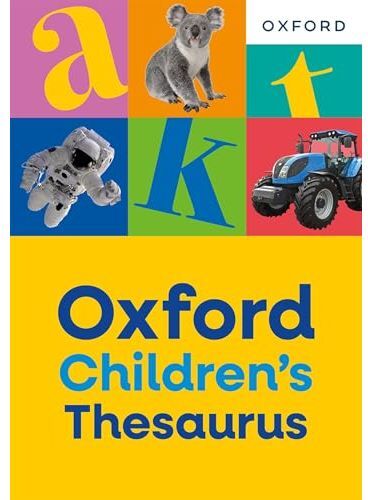
OUP Oxford Oxford Children's Thesaurus: Build vocabulary skills for ages 8+ with age-appropriate synonyms (Oxford Children's Dictionaries)Help children take their writing and speaking skills to the next level with the Oxford Children's Thesaurus - the essential vocabulary builder for young learners aged 8+. Perfect for home learning, homework support, or independent writing, this thesaurus inspires children to expand their language with thousands of exciting, creative, age-appropriate synonyms. Key features include: • Builds confident writing and speaking skills for ages 8+ (KS2), with thousands of exciting, creative synonyms designed specifically for children. • Clear, age-appropriate example sentences show synonyms in context, making it easy for young learners to understand and use new vocabulary independently. • Photographic images throughout help support comprehension and strengthen visual learning. • Easy-to-navigate design with alphabet thumb tabs, allowing children to quickly find the words they need for homework, school projects, or creative writing. • Includes a full writing supplement covering fiction, non-fiction, reports, and descriptive writing, helping children apply their new vocabulary in real tasks. • Overused Word panels offer smarter, more interesting alternatives to words like nice, good, big, and fun, helping children avoid repetition. • Writing Tips panels inspire creativity and help children experiment with tone, detail, and expression. • Word Web panels show related words and ideas to further develop vocabulary breadth and help children make richer word choices. • Powered by the Oxford Children's Corpus - a unique database of children's writing - ensuring vocabulary reflects real writing by real children and supports the words young learners actually use. • An ideal companion to the Oxford Children's Dictionary (9781382074117), supporting both vocabulary building and dictionary skills.7,99 £*Shipping: 2,99 £Secure redirect to the provider
-
Spelling and Vocabulary practice activities for children ages 6-7 (Year 2). Perfect for Home Learning.: (Scholastic English Skills)Master spelling and vocabulary and build English skills This workbook supports children to develop their spelling and vocabulary skills through fun and engaging activities which will help motivate your child's learning and confidence. A progress chart is also included for children to colour in as chapters are completed, and an introduction chapter on how to use the book. Content is split into: Back to basics; New spellins work: consonants; Focus on vowel sound; Super suffixes; More suffixes; Homophones and tricky words; and Spelling words with apostrophes. Help children feel prepared, capable and ready to tackle new challenges at school. Use at home or in school. Quickly builds confidence through regular, achievable activities that encourage independent learning. Designed to complement the school curriculum, meaning children work at the right level, so nothing feels too hard or too easy. Includes extra notes and tips to reinforce skills.4,99 £*Shipping: 1,99 £Secure redirect to the provider
-
What's That? Ladybird First Words & Pictures 4 Board Book Collection Set - Ages 1-3 - Bright First Vocabulary Books for ToddlersThis bright and sturdy four-book board book collection from Ladybird introduces toddlers to their very first words through four everyday themes: the farm, favourite animals, the home, and big machines. Designed specifically for little hands and curious minds, each book pairs a single bold picture with a simple word, helping babies and toddlers connect objects to language. Perfect for shared reading time, this set is an ideal first-words gift for any young child beginning their reading journey. Titles in This Set: - What's That? On the Farm - What's That? Favourite Animals - What's That? At Home - What's That? Big Machines About the Books: Each book in the What's That? series follows a simple, effective format: one clear, bright photograph-style illustration per page, paired with a single word naming the object or animal shown. What's That? On the Farm introduces toddlers to tractors, cows, and more. Details: Condition: New Format: Board Book Publisher: Ladybird Age Range: Ages 1-3 ISBN: 97802412878809,99 £*Shipping: 2,99 £Secure redirect to the provider



-
What is passive vocabulary and what is active vocabulary?
Passive vocabulary refers to the words that a person understands when they hear or read them, but may not necessarily use in their own speech or writing. Active vocabulary, on the other hand, refers to the words that a person can readily use in their own speech or writing. In other words, passive vocabulary is the words that a person recognizes and understands, while active vocabulary is the words that a person can actively use and express. **
-
Can economic efficiency and productivity develop mutually?
Yes, economic efficiency and productivity can develop mutually. When businesses and industries become more efficient in their operations, they can produce more output with the same amount of input, leading to increased productivity. Similarly, when productivity increases, it can drive economic efficiency by reducing waste and improving resource allocation. Therefore, as businesses and industries focus on improving efficiency and productivity, they can reinforce and support each other's development. **
-
How many vocabulary words are allowed for the vocabulary test?
The number of vocabulary words allowed for the vocabulary test is 20. Students are expected to study and understand the meanings and usage of these 20 words in order to demonstrate their vocabulary knowledge. This limit ensures that students focus on a manageable number of words and are able to thoroughly prepare for the test. **
-
How many vocabulary words are allowed in the vocabulary test?
The number of vocabulary words allowed in the vocabulary test can vary depending on the specific test or curriculum being used. In general, vocabulary tests can range from 10 to 50 words, with the number of words being determined by the grade level and the specific learning objectives of the test. It is important for educators to consider the appropriate number of words to assess students' vocabulary knowledge effectively without overwhelming them. **

What is the difference between efficiency and productivity?
Efficiency refers to how well resources are utilized to achieve a specific goal or output, while productivity measures the output or results generated from a specific amount of input or resources. Efficiency focuses on minimizing waste and maximizing output with the resources available, while productivity is a measure of how much output is produced relative to the input used. In essence, efficiency is about doing things right, while productivity is about doing the right things. **
What are the connections between efficiency and productivity?
Efficiency and productivity are closely connected in that efficiency refers to the ability to accomplish a task with minimal waste, effort, or cost, while productivity refers to the rate at which goods or services are produced. When a process or system is efficient, it can lead to increased productivity because it allows for more output to be generated with the same amount of input. Conversely, when productivity is high, it often indicates that the resources and processes are being used efficiently. Therefore, improving efficiency can lead to increased productivity, and vice versa, as they both contribute to the overall effectiveness of a business or organization. **
Top-Angebote
Products related to Vocabulary:
-
Learning Resources Scramboozle Educational Game for Kids - Ages 6+ - Encourages Critical Thinking and Boosts Vocabulary SkillsIntroduce your little ones to the exciting world of learning with the Learning Resources Scramboozle Educational Game for Kids. This engaging game is designed to make learning fun while enhancing essential skills such as critical thinking, vocabulary, and teamwork. With its colorful cards and playful design, Scramboozle stimulates imagination and encourages interactive play. Perfect for family game nights or friendly competitions, Scramboozle invites children to decode silly words and race against the clock. It’s a delightful journey into creativity and language that can be enjoyed by children aged 6 and up. Whether it's a gift for a birthday, a classroom resource, or a way to bond with friends, Scramboozle makes learning an adventure. This game encourages critical thinking and boosts vocabulary skills with its colorful and engaging design.8,79 £*Shipping: 3,95 £Secure redirect to the provider
-
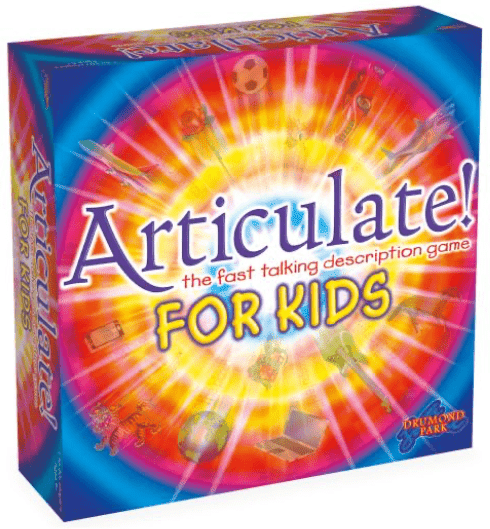
Articulate for Kids Board Game for Children Aged 6 and Older, Educational Vocabulary Development and Language SkillsArticulate for Kids is a board game designed to provide younger children with fun and educational entertainment. This junior version is suitable for children aged 6 and older, making it a great introduction to the original Articulate game. The game was compiled by an educational specialist and includes over 2000 entries in six categories, promoting vocabulary development and language skills in children. Players will have opportunities to describe and guess words and phrases in these categories, enhancing their communication abilities. The game comes with its own board, making it a complete and standalone game that can be played on its own.24,14 £*Shipping: 3,95 £Secure redirect to the provider
-
Multisell Products Hub DIY Voice Control Light Switch Module For Smart Home Automation With Tuya, Alexa & Google Home Integration DIY Voice Control Light Switch Module For Smart Home Automation With Tuya, Alexa & Google Home IntegrationUpgrade your home with the DIY Light Switch Module, bringing cuttingedge smart home automation to your fingertips. Perfect for those who want seamless control over their lighting and appliances, this module easily integrates with Alexa and Google...34,97 $*Shipping: 0,00 $Secure redirect to the provider
-
OUP Oxford Oxford Children's Thesaurus: Build vocabulary skills for ages 8+ with age-appropriate synonyms (Oxford Children's Dictionaries)Help children take their writing and speaking skills to the next level with the Oxford Children's Thesaurus - the essential vocabulary builder for young learners aged 8+. Perfect for home learning, homework support, or independent writing, this thesaurus inspires children to expand their language with thousands of exciting, creative, age-appropriate synonyms. Key features include: • Builds confident writing and speaking skills for ages 8+ (KS2), with thousands of exciting, creative synonyms designed specifically for children. • Clear, age-appropriate example sentences show synonyms in context, making it easy for young learners to understand and use new vocabulary independently. • Photographic images throughout help support comprehension and strengthen visual learning. • Easy-to-navigate design with alphabet thumb tabs, allowing children to quickly find the words they need for homework, school projects, or creative writing. • Includes a full writing supplement covering fiction, non-fiction, reports, and descriptive writing, helping children apply their new vocabulary in real tasks. • Overused Word panels offer smarter, more interesting alternatives to words like nice, good, big, and fun, helping children avoid repetition. • Writing Tips panels inspire creativity and help children experiment with tone, detail, and expression. • Word Web panels show related words and ideas to further develop vocabulary breadth and help children make richer word choices. • Powered by the Oxford Children's Corpus - a unique database of children's writing - ensuring vocabulary reflects real writing by real children and supports the words young learners actually use. • An ideal companion to the Oxford Children's Dictionary (9781382074117), supporting both vocabulary building and dictionary skills.7,99 £*Shipping: 2,99 £Secure redirect to the provider
-
Which vocabulary app scans the vocabulary list?
The vocabulary app that scans the vocabulary list is Quizlet. Quizlet allows users to scan their physical vocabulary list using their phone's camera, which then creates digital flashcards for studying. This feature makes it convenient for students to quickly digitize their vocabulary lists and access them for study on the go. **
-
What is the term for the vocabulary of nonverbal communication?
The term for the vocabulary of nonverbal communication is "kinesics." Kinesics refers to the study of body language, facial expressions, gestures, and other nonverbal cues that convey meaning in communication. Understanding kinesics is important for interpreting and responding to nonverbal signals in social interactions and can help improve overall communication skills. **
-
What is passive vocabulary and what is active vocabulary?
Passive vocabulary refers to the words that a person understands when they hear or read them, but may not necessarily use in their own speech or writing. Active vocabulary, on the other hand, refers to the words that a person can readily use in their own speech or writing. In other words, passive vocabulary is the words that a person recognizes and understands, while active vocabulary is the words that a person can actively use and express. **
-
Can economic efficiency and productivity develop mutually?
Yes, economic efficiency and productivity can develop mutually. When businesses and industries become more efficient in their operations, they can produce more output with the same amount of input, leading to increased productivity. Similarly, when productivity increases, it can drive economic efficiency by reducing waste and improving resource allocation. Therefore, as businesses and industries focus on improving efficiency and productivity, they can reinforce and support each other's development. **
Similar search terms for Vocabulary
-
Spelling and Vocabulary practice activities for children ages 6-7 (Year 2). Perfect for Home Learning.: (Scholastic English Skills)Master spelling and vocabulary and build English skills This workbook supports children to develop their spelling and vocabulary skills through fun and engaging activities which will help motivate your child's learning and confidence. A progress chart is also included for children to colour in as chapters are completed, and an introduction chapter on how to use the book. Content is split into: Back to basics; New spellins work: consonants; Focus on vowel sound; Super suffixes; More suffixes; Homophones and tricky words; and Spelling words with apostrophes. Help children feel prepared, capable and ready to tackle new challenges at school. Use at home or in school. Quickly builds confidence through regular, achievable activities that encourage independent learning. Designed to complement the school curriculum, meaning children work at the right level, so nothing feels too hard or too easy. Includes extra notes and tips to reinforce skills.4,99 £*Shipping: 1,99 £Secure redirect to the provider
-
What's That? Ladybird First Words & Pictures 4 Board Book Collection Set - Ages 1-3 - Bright First Vocabulary Books for ToddlersThis bright and sturdy four-book board book collection from Ladybird introduces toddlers to their very first words through four everyday themes: the farm, favourite animals, the home, and big machines. Designed specifically for little hands and curious minds, each book pairs a single bold picture with a simple word, helping babies and toddlers connect objects to language. Perfect for shared reading time, this set is an ideal first-words gift for any young child beginning their reading journey. Titles in This Set: - What's That? On the Farm - What's That? Favourite Animals - What's That? At Home - What's That? Big Machines About the Books: Each book in the What's That? series follows a simple, effective format: one clear, bright photograph-style illustration per page, paired with a single word naming the object or animal shown. What's That? On the Farm introduces toddlers to tractors, cows, and more. Details: Condition: New Format: Board Book Publisher: Ladybird Age Range: Ages 1-3 ISBN: 97802412878809,99 £*Shipping: 2,99 £Secure redirect to the provider
-
Usborne Publishing Usborne First Thousand Words Collection 2 Books Set by Heather Amery - Paperback - Ages 3-7 - English & French Vocabulary BuildersThis charming 2-book bundle brings together two beloved Usborne classics: First Thousand Words in English and First Thousand Words in French. Illustrated throughout by Stephen Cartwright, each book is packed with busy, colourful scenes for children to explore, name and talk about. Perfect for early vocabulary building at home or in the classroom, this set is a wonderful introduction to everyday English words and first steps in learning French, ideal for curious young readers and language learners alike. First Thousand Words in English is a classic of children's publishing, revised and updated for Usborne's 40th anniversary. It features a thousand everyday objects hidden within lively, detailed scenes — from the kitchen to the park.14,49 £*Shipping: 2,99 £Secure redirect to the provider
-
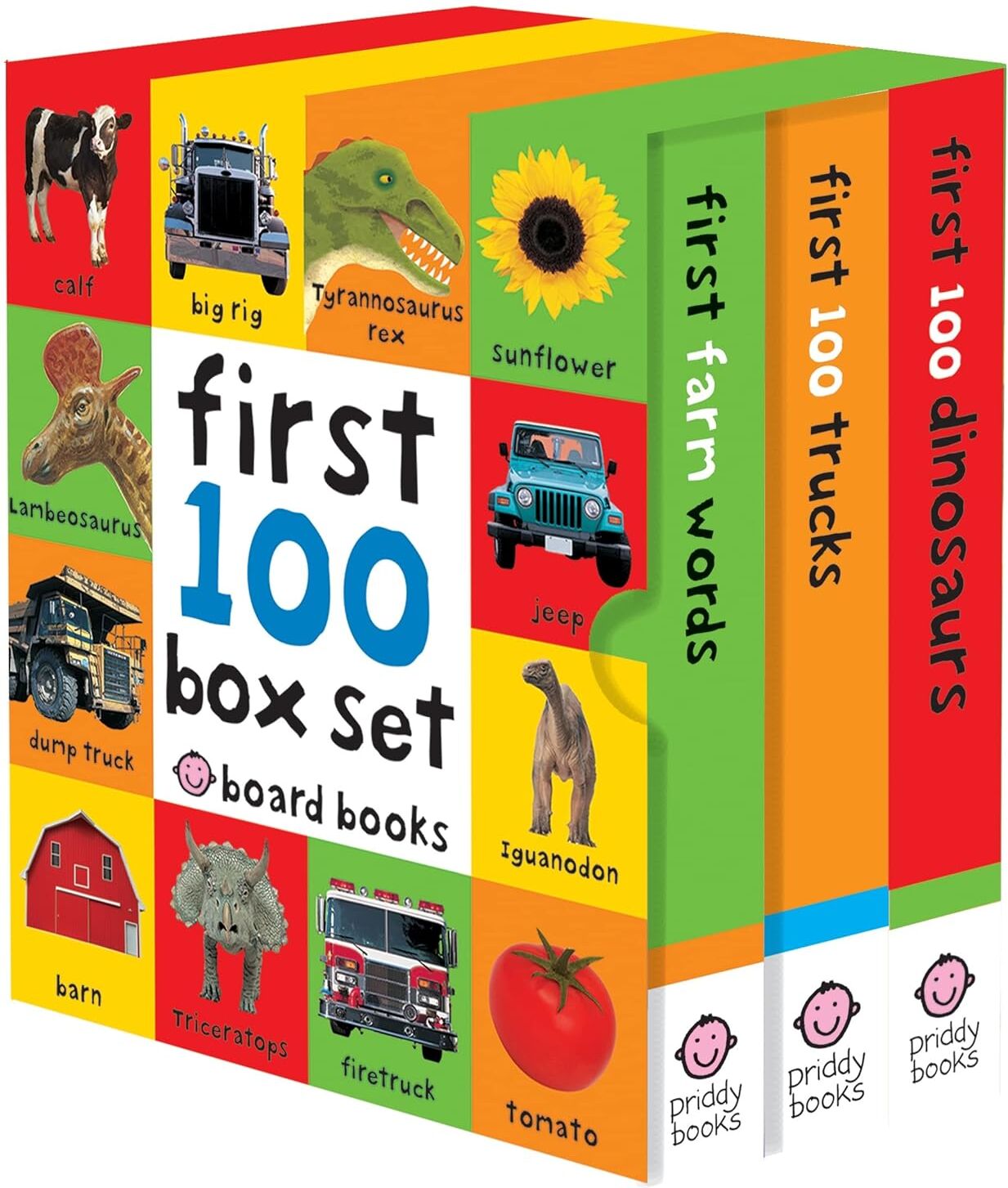
Priddy Books First 100 Box Set: Farm, Dino, Trucks by Roger Priddy - Board Book Set - Ages 0-5 - Early Learning Vocabulary BooksThe First 100 Box Set brings together three of Roger Priddy's bestselling early-learning titles in one sturdy slipcase. Featuring Farm, Dinosaurs, and Trucks, each board book uses bright photographic images and simple labelled words to build vocabulary. This compact and hard-wearing collection is ideal for little hands and makes a wonderful first library or gift set for any nursery shelf. Roger Priddy's First 100 series has become a firm favourite with parents and early-years educators thanks to its simple, effective approach to early word learning. Each of the three board books introduces 100 words through clear, vibrant photographs paired with bold, easy-to-read text. This set includes First Farm Words, First 100 Trucks, and First 100 Dinosaurs, all published by Priddy Books and suitable for children aged 0-5.8,49 £*Shipping: 2,99 £Secure redirect to the provider
-
How many vocabulary words are allowed for the vocabulary test?
The number of vocabulary words allowed for the vocabulary test is 20. Students are expected to study and understand the meanings and usage of these 20 words in order to demonstrate their vocabulary knowledge. This limit ensures that students focus on a manageable number of words and are able to thoroughly prepare for the test. **
-
How many vocabulary words are allowed in the vocabulary test?
The number of vocabulary words allowed in the vocabulary test can vary depending on the specific test or curriculum being used. In general, vocabulary tests can range from 10 to 50 words, with the number of words being determined by the grade level and the specific learning objectives of the test. It is important for educators to consider the appropriate number of words to assess students' vocabulary knowledge effectively without overwhelming them. **
-
What is the difference between efficiency and productivity?
Efficiency refers to how well resources are utilized to achieve a specific goal or output, while productivity measures the output or results generated from a specific amount of input or resources. Efficiency focuses on minimizing waste and maximizing output with the resources available, while productivity is a measure of how much output is produced relative to the input used. In essence, efficiency is about doing things right, while productivity is about doing the right things. **
-
What are the connections between efficiency and productivity?
Efficiency and productivity are closely connected in that efficiency refers to the ability to accomplish a task with minimal waste, effort, or cost, while productivity refers to the rate at which goods or services are produced. When a process or system is efficient, it can lead to increased productivity because it allows for more output to be generated with the same amount of input. Conversely, when productivity is high, it often indicates that the resources and processes are being used efficiently. Therefore, improving efficiency can lead to increased productivity, and vice versa, as they both contribute to the overall effectiveness of a business or organization. **
* All prices are inclusive of VAT and, if applicable, plus shipping costs. The offer information is based on the details provided by the respective shop and is updated through automated processes. Real-time updates do not occur, so deviations can occur in individual cases. ** Note: Parts of this content were created by AI.